
Introduction:
Starting to invest in the stock market can be overwhelming, especially for beginners. If you’re wondering how to invest in South Africa stock market, you have a lot to consider, including how financial markets work, global trends, and how to choose the right stocks. It might even seem like investing is only for experts. But if you want to invest on the South African Stock Exchange (JSE), you’re in the right spot. With the right guidance, anyone can start investing in stocks and build wealth.
This guide walks you through each step of investing on the JSE. I’ll share my own experiences and offer practical tips to help you get started. By the end, you should feel ready and confident to begin your journey toward financial success.
What Is the South Africa Stock Market (JSE)?
The Johannesburg Stock Exchange (JSE) is Africa’s largest and most recognized stock exchange. Based in Johannesburg, South Africa, it ranks among the world’s top 20 exchanges by market value. More than 300 companies are listed on the JSE, including major firms such as Naspers, Anglo American, and Standard Bank.
The Johannesburg Stock Exchange (JSE) was founded on November 8, 1887. It is located at One Exchange Square, 2 Gwen Lane, Sandown, Sandton, in Johannesburg, South Africa. The JSE is open from 9:00 AM to 5:00 PM (SAST).
The exchange lets investors buy and sell shares in publicly listed companies, giving them a stake in how those companies perform. It works like a marketplace where investors and businesses trade capital for ownership.
The basics of how to invest in South Africa stock market
Are you interested in learning how to invest in South Africa stock market but unsure how to begin? You’re in the right place.
Choosing to invest is an important step toward securing your financial future. With a well-planned investment portfolio, you can work toward your goals, protect your savings, save for retirement, or help pay for your children’s education.
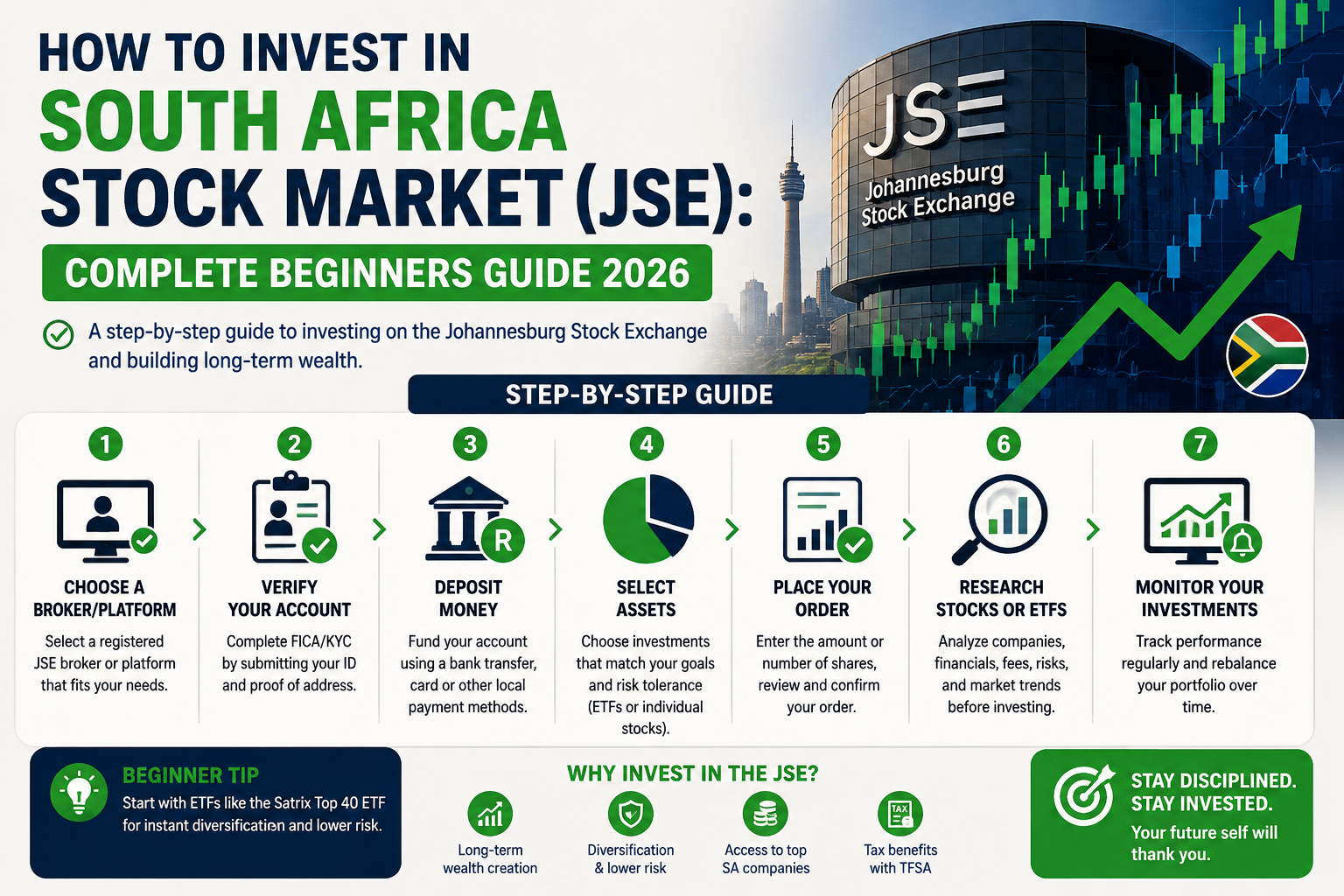
If you are new to investing in the Johannesburg Stock Exchange (JSE), start by opening an online account with an authorized stockbroker or platform. Next, complete the identity verification process (FICA), deposit your funds, and then choose company shares or Exchange-Traded Funds (ETFs) that fit your financial goals.
Step by Step Guide on How to Invest in South Africa Stock Market
1. Choosing the right stockbrocker platform/exchange
Investing in the JSE is now faster and simpler than ever, more than 40 stockbrokers are registered with the JSE. Some only carry out your instructions to buy or sell, while others also give advice and manage your investment portfolio.
Some brokers let you trade online, so you can choose shares, exchange-traded funds (ETFs), and other financial instruments on your own. Many also provide educational materials to help you learn more about investing.
2. Verify Your Account
To complete your account verification, please send us a valid government-issued ID and a recent proof of address. These steps help us confirm your identity, prevent fraud, and keep your account safe, as required by standard KYC and regulations.
Accepted documents may include a passport, national ID, driver’s license, utility bill, or recent bank statement. Ensure all documents are valid, clear, legible, and match the information registered on your account. Once submitted, we will review your documents and may request additional information if needed.
3. Deposit Money
Add money to your new trading account using a local payment method. Depending on where you are, you can use a bank transfer, debit card, mobile payment, or another supported option. Double-check your payment details and account information before you confirm. Once your deposit is processed and credited, your funds will be ready for eligible transactions.
4. Select assets
Pick investments that fit your goals and how much risk you are comfortable with. You might choose broad-market ETFs, like a Top 40 tracker, to invest in many companies at once and spread out your risk. If you want to focus on certain companies, you can buy individual stocks instead. Before you invest, consider potential returns, risks, fees, and how long you plan to keep your money invested.
5. Place your order
After choosing the asset you want, type in how much you want to buy or the number of shares in the trading section. Check the price, any fees, and your total investment before you confirm. Some platforms let you place a market order at the current price or set a limit order that only goes through at your chosen price. Once you confirm, watch your order to make sure it goes through.
6. Research Stocks or ETFs
Before you invest, spend some time learning about the stocks or ETFs you are interested in. Check out company financial reports, recent news about the industry, past performance, earnings, dividend details, and general market trends. If you are looking at ETFs, see what assets they include, what their fees are, and how much they spread out their investments. This research helps you see both the risks and opportunities, so you can make smarter choices instead of following market buzz or short-term price changes.
7. Monitor Your Investments
Investing usually means thinking long term, so it’s important to check your portfolio regularly. Pay attention to market trends, how companies are doing, and changes in the economy that might affect your investments. Try not to react to short-term market swings or let emotions drive your decisions. At least once a year, look over your portfolio to see if your investments still fit your goals, risk comfort, and timeline. If needed, rebalance your portfolio to keep it properly diversified.
Best Stock Brokers in South Africa for Beginners : How to Invest in South Africa Stock Market
If you are new to trading, it helps to pick a broker that is easy to use, offers learning materials, has clear fees, and provides good customer support. Here is a comparison of some platforms you might want to look into. Remember, CFD trading is risky, and you could lose more than you invest, so make sure you understand how it works before you start.
| Broker | Best For | Key Feature | Beginner-Friendly Notes |
|---|---|---|---|
| Capital.com | Beginners interested in CFDs | MT4 and AI-powered trading tools | Easy-to-use platform with educational resources and market analysis tools. |
| Libertex | CFD traders | Competitive/zero-spread offers on selected instruments | Straightforward interface with a range of trading instruments. |
| Plus500 | Simple CFD trading | Competitive spreads | User-friendly platform designed for relatively simple market access. |
| AvaTrade | CFD trading | Multiple trading platforms and leverage | Offers educational materials and tools, although leverage increases risk. |
| Absa Stockbrokers | South African investors | Local market access | South Africa-based option that may suit investors looking for local support and market exposure. |
| Interactive Brokers | Global investing | Access to 130+ markets | Broad international market coverage, although its extensive features may take beginners time to learn. |
| IG | Share dealing & CFDs | 10,000+ shares | Large selection of markets with research and educational resources for new investors. |
Stocks vs ETFs — What Should a Beginner Buy First? : How to Invest in South Africa Stock Market
What is the Stock Market?
The stock market is where people buy and sell shares, which are pieces of ownership in publicly traded companies. When companies sell shares, they can raise money to run and grow their business without relying only on loans or borrowing.
People buy and sell shares on official stock exchanges. In Africa, the Johannesburg Stock Exchange (JSE) is one of the largest and best-known. Investors can trade shares in large companies like Naspers Limited, Gold Fields Limited, FirstRand Limited, and many other top African businesses there.
What are Exchange Traded Funds (ETFs)?
Exchange-Traded Funds, or ETFs, are investment funds you can buy and sell on a stock exchange, much like regular shares. Each ETF usually follows the performance of a group of assets, such as stocks, bonds, commodities, or a market index. For instance, the FTSE/JSE Top 40 Index includes some of the biggest companies on the Johannesburg Stock Exchange.
With ETFs, investors can access a range of assets with a single investment. This makes it easier to diversify, saves time, and is often cheaper than buying each security separately.
If you are new to the Johannesburg Stock Exchange (JSE), starting with an Exchange-Traded Fund (ETF) is a practical choice. An ETF lets you invest in a mix of companies at once, which helps spread out your risk and means you do not have to spend a lot of time researching individual stocks.
Why Start with Exchange Traded Funds (ETFs)?
1. Instant Diversification
Buying a single unit of an ETF like the Satrix Top 40 ETF lets you invest in many leading companies on the Johannesburg Stock Exchange (JSE). Rather than investing all your money in just one company, your money is spread across different businesses and sectors, such as banks, mining companies, retailers, and other big industries. This mix helps lower the risk if one company does poorly, and it gives beginners an easy way to access a wide range of the market with just one investment.
Lower Risk
When you invest in a diversified ETF, you lower the risk that comes from any one company doing poorly. If one company in the group has a tough year or its stock drops, the other companies in the ETF can help balance out those losses. Since your money is spread across different businesses and industries, you are not relying on just one company’s results. Still, diversification cannot remove all risk, and an ETF’s value can fall if the whole market drops.
Tax Benefits
You can hold some JSE-listed ETFs in a Tax-Free Savings Account (TFSA), which lets eligible investors enjoy tax-free growth and returns, as long as you follow South African TFSA rules and contribution limits. Some ETF purchases might also be exempt from Securities Transfer Tax (STT), depending on how you buy them. Before you invest, review the ETF details and the latest SARS rules to see which taxes and exemptions apply.
Low Cost
ETFs can make it easier to start investing, as you can begin with a small amount of South African rands instead of needing a lot of money to buy individual shares. With just one ETF, you get access to many companies at once, so you do not have to buy several different shares on your own. Still, look at brokerage fees, platform charges, and the ETF’s management costs before you invest.
When to Move to Individual JSE Stocks : How to Invest in South Africa Stock Market
After you learn how the market works and feel confident reading company financial statements, you might think about adding some JSE-listed stocks to your portfolio. Individual shares can grow more than diversified ETFs, but they also come with more risk tied to each company. To be careful, you could put only a small part, like 10% to 15%, into companies you have researched well, while keeping most of your money in ETFs as the main part of your portfolio. This way, you can get experience with individual stocks without risking all your investments.
Frequently Asked Questions (FAQs) on How to Invest in South Africa Stock Market
1. Can foreigners buy JSE stocks?
Yes, foreign investors can generally buy JSE-listed shares by using a broker that works with international clients. When you open an account, you will need to provide identification and e some tax or regulatory information.
2. Do I need a local bank account or Rand (ZAR) account?
Not always. Some international brokers let you fund your account in a foreign currency and will convert it to South African rand for you. Each broker has different requirements.
3. What are the best beginner apps and platforms?
Popular choices include EasyEquities, SatrixNOW, Absa Stockbrokers, IG, and Interactive Brokers. When deciding, look at the fees, the types of investments offered, how easy the platform is to use, and if it accepts clients from your country.
4. What is the minimum money needed to start?
No universal minimum amount is required; it applies to all JSE investments. Many platforms let beginners start with small sums, so you can grow your investment over time.
5. How do taxes and currency exchange affect returns?
If you invest from outside South Africa, your returns may be influenced by capital gains tax, dividend tax, and value. The taxes you owe will depend on where you live and your personal situation.
6. Can I buy JSE shares without a broker?
Usually, you cannot trade JSE shares on your own. You need to use a licensed stockbroker or an investment platform. The broker will place your orders and give you market access.
Conclusion on How to Invest in South Africa Stock Market
Investing in the JSE can be straightforward. Start by choosing a reliable broker, consider a diversified ETF, do your research, and monitor your portfolio. These steps help you build a solid base for long-term investing.
Start with an amount you are comfortable investing, understand the risks, and stay focused on your financial goals rather than daily market changes. If you stay patient, disciplined, and keep learning, the JSE can help you build wealth over time.